Crown vs. ROPP vs. Bar Top? How to Choose the Right Closure
If you’re a beverage producer, the closure on your bottle is doing more work than most people realize. It’s maintaining carbonation, preventing oxidation, communicating brand positioning, meeting tamper-evidence requirements, and surviving the entire supply chain — all at once. And yet, closure decisions are often made late in the product development process, or based on habit rather than fit.
At Capsules & Closures, we talk to producers every day who are scaling a new product, reformulating a line, or moving into a new category. One of the most common questions we hear is some version of: “What closure should I be using?”
The honest answer is: it depends. But it depends on very specific, answerable things — your product type, your production setup, your price point, and your brand story. This guide walks through the three most common closure types we supply, what they’re each best suited for, and how to think about the decision.
Crown Caps: The Classic That Still Earns Its Place
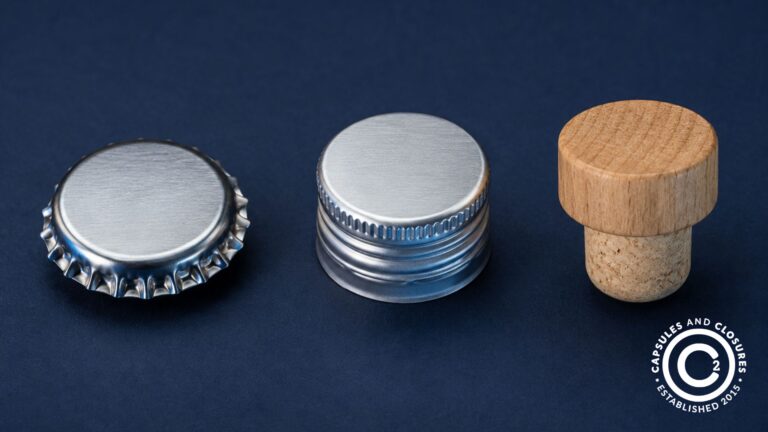
The crown cap has been the dominant closure for beer bottles since 1892, when mechanical engineer William Painter patented his “Bottle Sealing Device” — a crimped metal cap that solved the carbonation-loss problems that had plagued brewers for decades. More than 130 years later, it remains the global standard for bottled beer, and for good reason.
What makes crown caps work:
Crown caps provide an exceptionally tight, airtight, and leak-proof seal that’s critical for maintaining carbonation in beer, kombucha, sparkling water, and other carbonated beverages. The crimped seal is highly effective at preventing oxygen ingress, which is one of the primary enemies of beer quality. They’re also cost-effective at scale — among the least expensive closure options per unit, which matters when you’re filling at volume.
For craft brewers specifically, the standard (non-twist) crown cap has a functional advantage that’s worth noting: many brewers believe the traditional crown provides a better oxygen barrier than twist-off versions, and the twist-off has historically carried an association with mass-market beer that craft producers tend to avoid. The satisfying pop of a standard crown cap is also part of the product experience — a sensory detail that’s easy to underestimate.
On the branding side, the crown cap’s printable surface makes it a powerful, low-cost branding real estate. Custom colors, logos, and limited-edition cap designs are increasingly used by craft brewers and specialty beverage brands to drive shelf recognition and consumer engagement. The U.S. crown caps market was valued at $399.8 million in 2025, with craft beer and specialty beverage producers among the key drivers of innovation in cap design.
Best suited for:
- Craft beer (bottles)
- Kombucha
- Sparkling soft drinks, tonics, and sodas
- Sparkling water and specialty carbonated beverages
- Any bottled beverage where carbonation retention and cost-per-unit matter
Worth considering: Crown caps require a crimping machine compatible with your production line. If you’re at low volume or just starting out, make sure your bottling setup supports crown application before committing to the format.
ROPP Aluminum Closures: The Premium Standard for Spirits, Wine, and Beyond
ROPP stands for Roll-On Pilfer-Proof — a name that tells you exactly what this closure is designed to do. Unlike a pre-threaded screw cap, an ROPP closure starts as a smooth aluminum shell that is threaded directly onto the bottle during capping, forming a custom-fit seal unique to that bottle’s neck finish. A scored tamper-evident band at the base breaks permanently on first opening, providing an unmistakable signal of product integrity.
The result is a closure that offers exceptional sealing performance, premium aesthetics, and built-in tamper evidence — which is why ROPP has become the dominant closure format for spirits, wine, and premium non-alcoholic beverages.
What makes ROPP closures work:
For wine producers, the ROPP closure eliminates the risk of cork taint — the musty off-flavor caused by TCA contamination in natural cork — while ensuring consistent sealing quality across every bottle. This has made ROPP increasingly popular among winemakers seeking reliability at scale, particularly for everyday and mid-range wines where cork taint risk outweighs the traditional prestige of a natural cork.
For spirits producers, ROPP is the global standard. The 31.5mm diameter segment dominates the spirits bottling market due to its compatibility with high-speed capping lines and standardized bottle neck finishes across the industry. The aluminum surface also offers extensive customization options — embossing, anodizing, color coating, and high-precision printing — making it a branding tool as much as a functional seal.
The ROPP market reflects this demand. The global aluminum ROPP closure market is valued at $3.4 billion in 2025 and projected to reach $6.1 billion by 2035, driven by premiumization in spirits and wine packaging and the growing need for tamper-evident solutions. Beverages account for 48.5% of all ROPP closure demand, with alcoholic beverage applications projected to grow at a 3.2% CAGR through 2035.
Beyond spirits and wine, ROPP is increasingly the closure of choice for premium functional beverages, specialty juices, and non-alcoholic alternatives that want to signal quality through their packaging. If your product is in a glass or PET bottle and commands a higher retail price point, ROPP is worth serious consideration.
Best suited for:
- Spirits (whiskey, vodka, rum, tequila, gin, and more)
- Wine (still, sparkling, and fortified)
- Premium non-alcoholic beverages, juices, and functional drinks
- Olive oil, specialty condiments, and premium food products
- Any bottled product where tamper evidence, shelf presence, and premium positioning matter
Worth considering: ROPP application requires a capping machine with ROPP capping heads. These are a meaningful equipment investment compared to simple screw-cap or crown systems. If you’re running a small-batch operation, confirm your capping setup before specifying ROPP.
Bar Top Corks: When the Unboxing Experience Is the Point
Bar top corks — sometimes called T-top closures — are the two-part closure consisting of a cork or synthetic shank that inserts into the bottle neck, topped with a decorative head made of wood, metal, glass, ceramic, or plastic. They don’t seal with a screw thread or a crimp; they seal with friction, and they open with a simple pull.
If that sounds less functional than the other options, that’s a fair read. Bar top corks are not optimized for long-term product preservation or high-speed bottling lines. What they’re optimized for is presentation — and in the right context, that’s exactly what’s needed.
What makes bar top corks work:
Bar top closures are strongly associated with premium spirits, artisanal products, and gift-driven purchasing. A whiskey with a solid wood bar top communicates craftsmanship and quality at a glance — it’s a closure that invites the consumer to linger, examine, and feel good about the purchase before they’ve taken a single sip. Decorative closures like these have been shown to drive shelf recognition and boost recall, making them a meaningful tool for brands competing at the premium end of the market.
For craft distilleries, small-batch spirits producers, artisan winemakers, and specialty food brands, bar top corks offer significant branding flexibility. Custom-engraved wood tops, branded metal caps, and decorative glass stoppers are all common — and they translate directly into higher perceived value on the shelf and in the gift market.
The trade-off is that bar top closures are less suited to products intended for long-term aging or storage. Cork shanks can dry out over time if bottles aren’t kept upright, and the friction seal isn’t as airtight as a well-threaded ROPP. For products meant to be consumed relatively soon after purchase — most craft spirits, infused oils, specialty sauces, and aperitifs — this isn’t a practical concern. For products meant to age in the bottle over years, it is.
Best suited for:
- Craft spirits (whiskey, bourbon, gin, rum, mezcal)
- Artisan liqueurs and aperitifs
- Specialty olive oils, infused vinegars, and premium condiments
- Gift-driven and limited-edition releases
- Any product where the unboxing or gifting experience is a meaningful part of the brand
Worth considering: Bar top corks require either hand insertion or a simple press, making them feasible for small-batch production without major equipment investment. They’re not well suited for high-speed automated bottling lines. Also factor in the type of cork shank: natural cork, synthetic, or agglomerate each has different performance and sustainability characteristics.
The Decision Framework: How to Think About Choosing
With those three options in view, here’s a simple way to think through the decision:
If your product is carbonated and bottled — crown cap is almost always the right call. The economics, the seal integrity, and the production compatibility are all in its favor.
If your product is a spirit, wine, or premium non-carbonated beverage and you’re running at meaningful volume with a bottling line — ROPP is the standard for good reason. It delivers premium presentation, reliable tamper evidence, and consistent sealing at speed.
If your product is a craft spirit, artisanal food product, or anything gift-forward — and you’re at lower volume with higher unit prices — bar top corks deserve serious consideration. The presentation value is real, and for the right product, it can be the detail that closes the sale at the shelf.
And of course, these aren’t mutually exclusive. Many producers use ROPP for their main line and bar top corks for limited releases or gift packaging. Others transition from bar top to ROPP as they scale. The closure decision should evolve with your brand and your production reality.
A Note on Liner Selection
Whichever closure format you choose, the liner — the small disc of material inside the cap that makes contact with the bottle rim — is as important as the cap itself. The wrong liner for your product can affect flavor, compromise the seal, or create compatibility issues with your filling process. For carbonated beverages, oxygen-scavenging liners are worth exploring. For spirits and wines, liner material needs to be chemically inert with respect to the product’s ABV. This is a conversation worth having with your closure supplier before you finalize specs.
We're Here to Help
At Capsules & Closures, we supply crown caps, ROPP aluminum closures, bar top corks, tamper-evident plastic closures, LUG closures, CT closures, PVC capsules, and more — across beer, wine, spirits, kombucha, juice, functional beverages, and food. We also handle our own freight, which means fewer handoffs and faster lead times than many suppliers.
If you’re working through a closure decision for a new product, a reformulation, or a packaging upgrade, we’d love to be part of that conversation. Reach out to our team — we’re happy to talk through what makes sense for your product, your line, and your brand.
About Capsules and Closures
Capsules & Closures, LLC is a leading U.S.-based supplier of lids, crowns, closures, bar tops, cans, and capsules for the food and beverage industry. For questions on sourcing, pricing, or market conditions, contact Capsules & Closures directly.